


Frictionless onboarding has become the goal for any company signing up new customers through digital channels. The challenge lies in the balance: every extra verification step lowers fraud risk, but it also raises the chance that the user gives up halfway through.
A McKinsey study shows the size of that pain point: 60% of Brazilian corporations reported an increase in fraud losses over the past two years. Latin America as a whole could avoid up to US$65 billion in losses by better balancing prevention and user experience.
This tension isn't exactly new. It's a pain that has grown alongside the rise of Brazil's digital economy itself.
Jason Howard, CEO of Certta, summed up this market shift during Conexão Certta, an event the company hosts for leaders across Brazil's anti-fraud industry: “Digitalization stopped being a choice and became an obligation.”
That shift, accelerated by the pandemic, drove up risk and fraud and added complexity to flows that used to work just fine, pushing Certta and the rest of the market to reinvent themselves.
For years, the market treated this tension as an inevitable trade-off, where more security meant more friction and more conversion meant more risk. Recent data on digital behavior and fraud in Brazil tells a different story. Brazilian users aren't willing to accept that trade-off anymore, and companies that ignore this conflict end up losing on both fronts, with more funnel abandonment and more fraud slipping through the cracks.
Why Brazil Has the World's Most Demanding Onboarding Environment
This balance takes on a particular weight in Brazil, driven by a culture of digital instantaneity that runs through banking itself. Pix, Brazil's instant payment system, cemented the expectation that any financial transaction happens in seconds, and mobile channels are already the country's main banking touchpoint.

The 2026 Banking Technology Survey, conducted by Febraban (the Brazilian Banking Federation) and published by Deloitte, shows the scale of this:
- 240.8 billion banking transactions recorded in the country;
- 83% of operations already happen on digital channels, 78% through the mobile app alone;
- 63% of corporate (B2B) transactions are already made via mobile;
- 76% of users are already heavy users, concentrating more than 80% of their transactions on digital channels.
At the same time, Brazil ranks 6th globally in suspected digital fraud, according to TransUnion's Global Omnichannel Fraud Trends Report, published in June 2025. The country is home to one of the most sophisticated criminal ecosystems in the world. Fraud rings there use genuine documents obtained fraudulently, synthetic facial biometrics, and hyper-personalized social engineering on an industrial scale.
The same TransUnion report found that 40% of Brazilians have already been targeted by digital fraud attempts, and 10% actually fell victim to a scam. That level of exposure helps explain why Brazilians default to distrust of any new sign-up: the country's interpersonal trust index sits below 7%, one of the lowest in the world, according to the World Values Survey.
The Cost of Onboarding Friction: The Economics of Drop-off
This scenario puts risk teams between two opposing pressures. The business side wants fewer steps, while compliance wants more controls. Meanwhile, the end user decides in seconds whether to continue signing up or abandon ship for a competitor.
What Friction in the Sign-up Funnel Actually Costs
Losing customers during sign-up isn't just an operational hiccup. It's a financial inefficiency that eats into the return on acquisition campaigns.
Global studies from Fenergo show that 70% of financial institutions have already reported losing customers to slow, broken onboarding, up from 48% in 2023 and 67% in 2024. The average drop-off rate in complex onboarding flows has stabilized around 10% globally.
Consumer behavior confirms this intolerance for bureaucratic journeys. Digital behavior research compiled by SundaySky shows that 72% of consumers abandon a brand's app if sign-up requires excessive or repetitive steps.
Every extra minute of friction in a flow cuts final conversion by roughly 3%, according to studies cited by SHNO. Half of users (50%) quit onboarding if they don't understand how to use the app or hit technical roadblocks in the first three minutes of interaction.
The Payoff of a Good Onboarding Experience
The reverse is measurable too. Companies that prioritize the first-contact experience see 1.9 times higher customer retention and 2.1 times higher lifetime value (LTV) than competitors who neglect this step, according to a 2018 Forrester Research study commissioned by Adobe and cited by SundaySky.

Fixing a technical glitch or an identity-verification failure right at first contact can mitigate up to 67% of subsequent churn, which matters given that 44% of digital account cancellations happen within the first 90 days, according to a Marketing LTB survey published in November 2025.
Why Onboarding Friction Isn't the Same as Security
The most common mistake is treating every verification step as equally protective, when in reality a rigid, one-size-fits-all barrier is very different from a smarter, adaptive check. Adding a manual review step, requesting an extra document, or inserting a redundant check increases onboarding time, but it doesn't necessarily stop someone actually trying to commit fraud. Professional fraudsters know the flow as well as the team that designed it, and they adapt to every new static barrier.
Meanwhile, friction weighs more heavily on legitimate users, who have no reason to hide anything and simply have no patience for repeating steps. The result is a perverse equation: the company raises its acquisition cost by losing good customers in the funnel, without necessarily reducing how many fraudsters get in.
That difference weighs even more on smaller businesses: roughly 70% of Latin American SMBs depend on digital payment methods to operate, according to a Poder360 report published on July 17, 2026, which makes any unnecessary sign-up friction a direct risk to these companies' cash flow. Carlos Eduardo Merlin, CRO of Certta, sums up why the market's answer can't just be stacking more security tools:
“The debate around this new category in Brazil shows how it's possible to centralize intelligence, cross-reference data in a single environment, bring in expertise from different segments, and carefully curate the right tools, without losing sight of the impact on the end user's experience.” Carlos Eduardo Merlin, CRO of Certta, in an interview with Inforchannel and Segs (April 2026)
How Fraud Evolved in Brazilian Digital Onboarding
How Fraud Tactics Changed in Brazil
Designing a balanced onboarding flow requires understanding the criminal dynamics it's up against. According to Febraban's security index:
- scam attempts rose from 33% at the end of 2024 to 38% in the first quarter of 2025;
- the most susceptible profiles are men (44%), seniors 60 and older (42%), and people with a college degree (41%);
- financial institutions already spend around R$5 billion (roughly US$1 billion) a year on cybersecurity and fraud prevention.

As brute-force account takeovers became unfeasible with the adoption of two-factor authentication, crime shifted toward directly manipulating the user. Data from BioCatch's threat report shows:
- malware-initiated payments that hijack the phone screen grew 200% in the first half of 2025;
- fake call center scams doubled in volume in one year;
- incidents tied to stolen or compromised mobile devices tripled in the country;
- fraud within the Pix ecosystem expanded 43% in volume, with R$2.7 billion (about US$510 million) in losses accumulated over two years.
“Today, with generative AI, anyone can download a fraud kit and build a sophisticated attack.” Gabriel Pato, ethical hacker and founder of Pato Academy, Brazil's largest information security channel
Most Reported Scams Among Brazilian Consumers
Among Brazilian victims, the most reported scams follow an identifiable pattern:
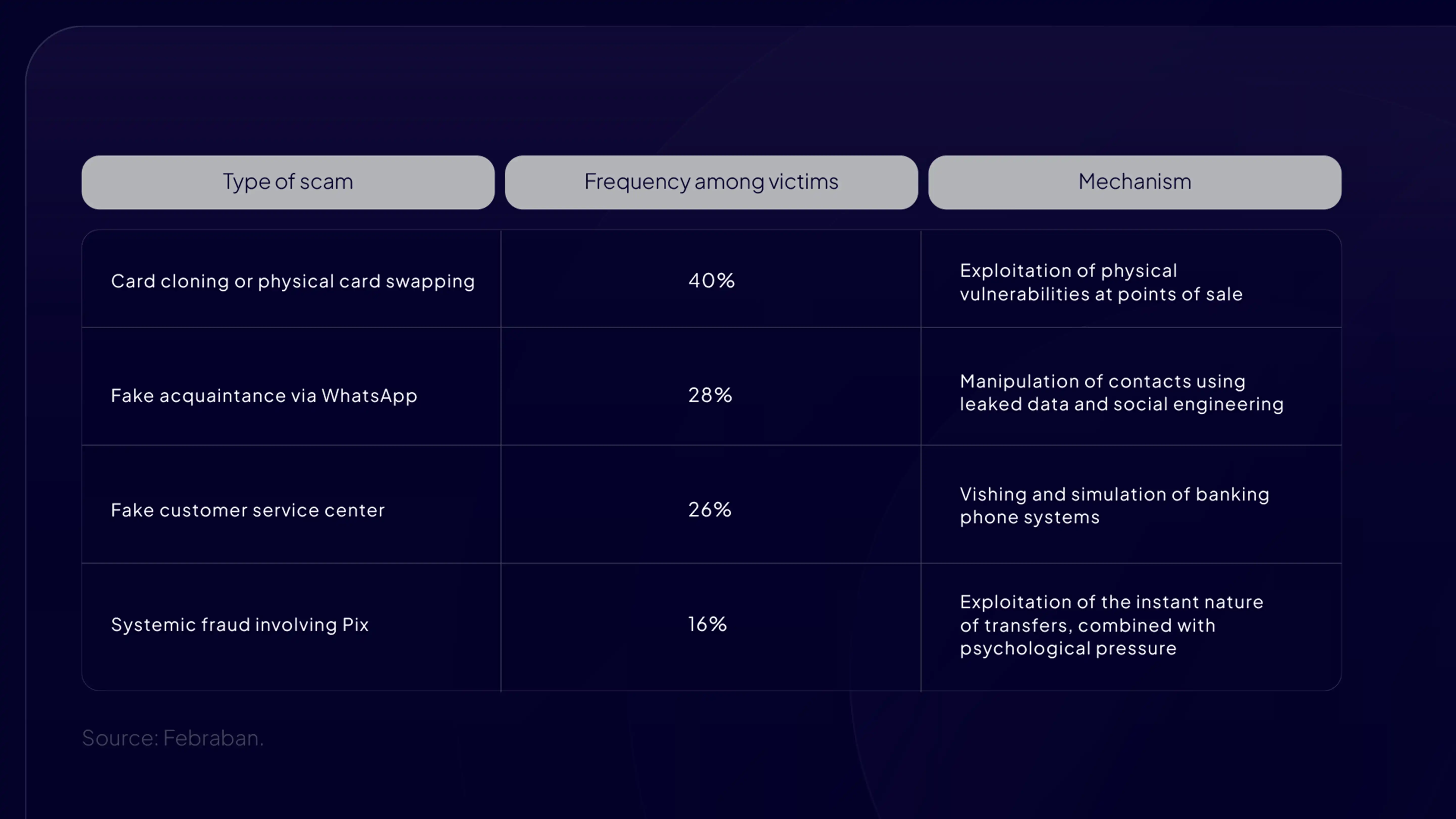
These scams rarely end at sign-up itself. Weak onboarding, opened with a fake document or synthetic biometrics, tends to generate so-called mule accounts: accounts opened in someone else's name that later get used to take out loans, buy goods and services on installment plans, or launder money. Onboarding acts as the barrier that stops this larger kind of fraud before it happens, not as a process isolated from the rest of the business's risk.
Adaptive Verification and Progressive Profiling: What Changes in Onboarding
A user opening a fintech account while waiting for a flight does it in under two minutes or gives up. A fraudster trying the same flow with purchased data has all the time in the world to test each step. Treating both with the same level of verification is exactly what makes onboarding slow for legitimate users and permeable for everyone else.
The alternative gaining ground in the market starts from a different principle: intelligently routing transactions according to risk level, instead of cutting security across the board.
Adaptive verification adjusts the intensity of controls based on the risk identified in each session. A user with a clean history goes through a lean flow. A user showing risk signals gets routed to other verification combinations, aimed at safely confirming who's really on the other side.
Progressive Profiling: What It Is and How It Works
This logic relies on progressive profiling: collecting user data gradually over the course of the relationship, instead of demanding everything at first sign-up. At initial registration, the company asks only for the bare essentials, like an email address and a simple biometric credential, leaving additional validation for the moment the user initiates a higher-risk transaction.
According to identity architect Deepak Gupta, this approach cuts the time to complete initial sign-up from a historical average of 180 seconds to about 12 seconds.
The signals collected over that relationship go beyond documents and biometrics. José Oliveira, CTO of Certta, describes the level of granularity advanced systems can read: Is the phone permanently plugged in? Does the user always operate with their right hand, then suddenly switch to their left? What does the timing and location pattern of their transactions look like?
Each of these signals feeds a risk score that drives the decision in real time, without the legitimate user ever noticing they're being assessed.
Efficiency Results With Adaptive Verification
Personalized onboarding journeys raise full sign-up completion rates by up to 35%, according to SundaySky. Marcelo Sousa, VP of Product at Certta, sums up the challenge:
“Fraud has become cheap, sophisticated, and scalable for attackers. That's exactly why financial institutions need tools that evolve at the same speed as the threats, without every adjustment requiring a ticket filed with the development team.” Marcelo Sousa, VP of Product at Certta
Sousa adds that, in dynamic credit and onboarding environments, identifying anomalous behavior depends on cross-referencing several signals at once, like geolocation, biometrics, and document integrity.
How an Intelligent Verification Hub Reduces Onboarding Friction
Putting this logic into practice requires a platform capable of changing risk rules as fast as fraud evolves, without depending on a new development cycle for every adjustment. An intelligent verification hub brings together natively integrated intelligence layers on a single platform, covering the journey from sign-up through continuous monitoring.

Neli Freitas, president of Risk Women Brasil, a community of more than a thousand women professionals working in digital risk prevention across 140 companies, sums up what risk teams face day to day:
“The challenge is having to look at these layers as a whole, because you're talking about a single journey, whether it's the fraudster's or the customer's. Having a hub that brings that together, that looks at it globally and delivers it with operational efficiency, is extremely valuable.” Neli Freitas, president of Risk Women Brasil
Flow: No-code Centralization of Anti-fraud Strategy
Flow, from Certta, lets risk teams configure and adjust verification flows without relying on development. Decision logic stays centralized in a single visual environment, which shortens the time between spotting a new threat and putting the response into production.
“Having access to the best technologies on the market isn't enough if it takes the company weeks to put them into practice. Flow exists precisely to power our hub and turn customer operations into a living infrastructure, one that can continuously adapt to user behavior, regulatory changes, and fraudsters' new tactics.” José Oliveira, CTO of Certta
Onboarding Builder: Visual Assembly of Sign-up Journeys
Onboarding Builder is the other personalization front within the same hub. While Flow decides the risk logic behind the flow, Onboarding Builder visually assembles the sign-up journey itself: the screens, the fields, and the order of the steps the user sees. Both tools run on the same platform and complement each other: one defines what to verify and when, the other defines the experience the user goes through to get there.
authID: Continuous, Context-based Authentication
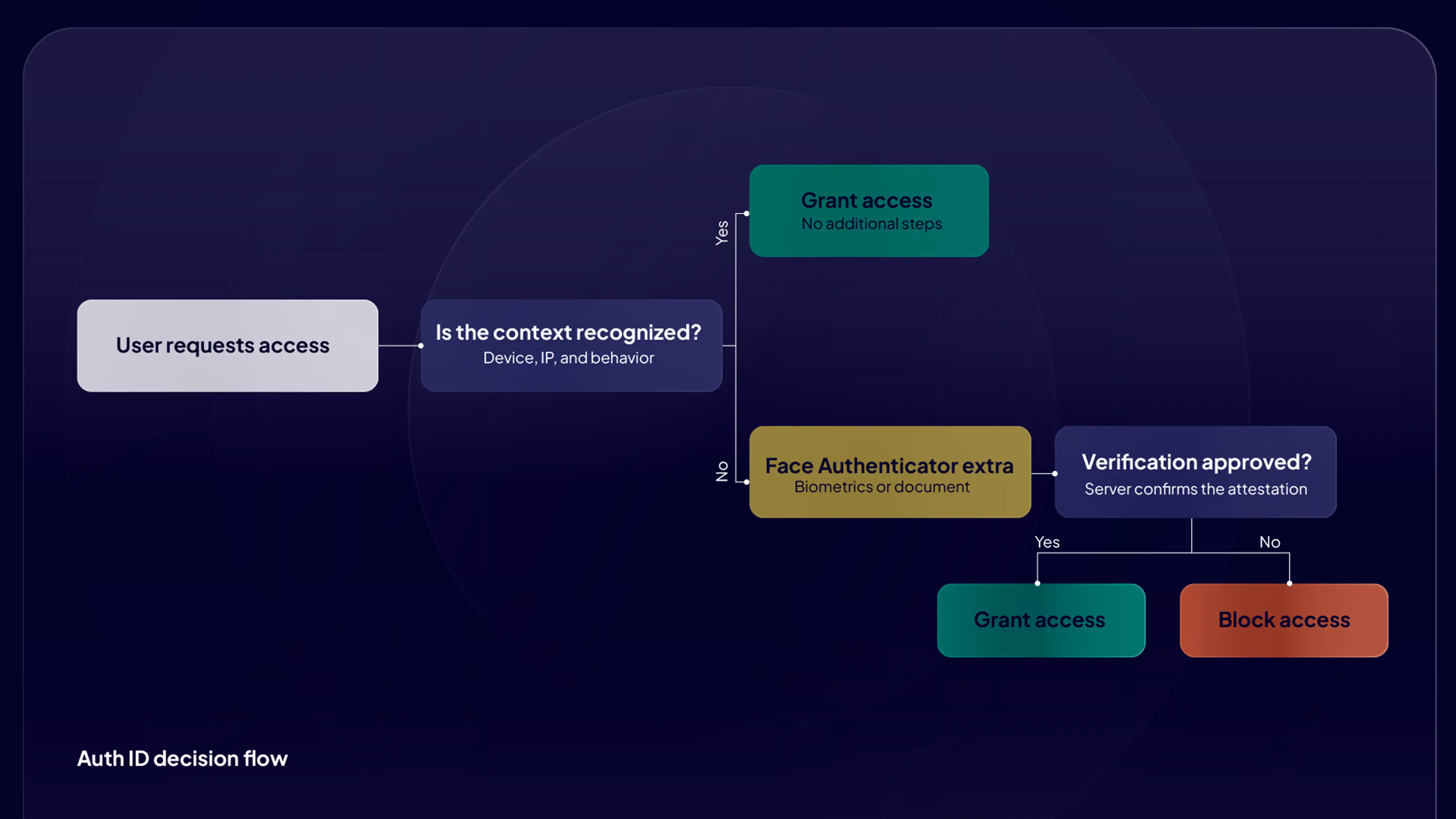
authID reinforces this same logic at the authentication layer. Its goal is to confirm that the logged-in user really is who they claim to be, working as an additional authentication factor for identities already on file.
When the session context is recognized, such as device, geolocation, and behavior consistent with the user's history, the system returns a proof of authenticity without asking the person for anything more. When the context falls outside the norm, the SDK automatically triggers the necessary re-authentication steps, and only grants access once all of them are approved.
Regulation and Onboarding Friction: The Sports Betting Example
Onboarding design also responds to regulatory requirements. The clearest example in the Brazilian market is in the fixed-odds sports betting sector. Ordinances SPA/MF No. 1,225 and No. 1,231, issued by Brazil's Secretariat of Prizes and Betting under the Ministry of Finance, require licensed operators to validate and annually update every bettor's data. If a customer fails to authenticate their data within the deadline, the operator must suspend account access immediately.
The regulation also requires platforms to keep a history of replaced data, including the IP address used in every profile change. That pressure forced the industry to build biometric validation directly into initial sign-up, reducing identity cloning and accounts opened under someone else's name for money laundering.
Five Guidelines for Balancing Friction and Security in Onboarding
- Replace manual friction with back-office automation. Manual data entry is the single biggest drop-off driver in Brazilian onboarding. Intelligent document capture eliminates entry errors that invalidate sign-up and force users to repeat steps.
- Adopt dynamic AI layers. Models that read unstructured documents and detect synthetic biometrics can keep pace with the evolution of scams like deepfakes and hyper-personalized social engineering.
- Centralize decisions in an intelligent verification hub. Running isolated tools means every strategy change depends on a new development cycle and separate integrations. Unifying decision logic in one place cuts that response time.
- Move to progressive profiling. Collect only what's necessary at first contact and leave additional validation for the moment risk actually calls for it. This cuts initial sign-up time without giving up deeper controls when they're needed.
- Guarantee automatic provider fallback. Fallback is the mechanism that automatically switches to another provider or verification method when the primary one becomes unstable. Without it, a single provider's outage locks out legitimate users and pushes conversion to a competitor.
Certta helps risk teams configure the right level of verification for each user, without depending on a new development cycle for every adjustment. Talk to a specialist and see how to reduce friction in your onboarding.
Frequently Asked Questions
What is frictionless onboarding?
It's a sign-up process that reduces manual, repetitive steps for the user, using data automation, biometrics, and adaptive verification to confirm identity without requiring the same effort from everyone.
Does reducing onboarding friction increase fraud risk?
Not necessarily. Risk increases when friction is removed without an equivalent control in place. When verification becomes adaptive and risk-signal-based, it's possible to cut steps for legitimate users without opening a door for fraudsters.
How do I know if my company's onboarding has unnecessary friction?
The first sign is a drop-off rate concentrated in one specific step of the flow, usually manual data entry or repeated document uploads. Measuring drop-off by step, not just the total, is the starting point.
Is adaptive verification the same as less security?
No. Adaptive verification directs more control toward whoever shows risk signals and less toward whoever doesn't. Total protection doesn't drop. It just gets redistributed more precisely.
Can regulated industries reduce onboarding friction too?
Yes, as long as automation replaces manual steps without eliminating legal requirements. Brazil's sports betting sector, for example, has to validate biometrics and keep a data history, and still manages to automate much of that process.
What are the main frictionless onboarding techniques?
The main ones are data automation (automatic document reading instead of manual entry), facial biometrics for identity confirmation, adaptive verification that adjusts the control level to each session's risk, progressive profiling to collect data gradually, and automatic fallback between verification providers to keep a technical outage from locking out a legitimate user's sign-up.
Concepts
Friction: Any onboarding step that requires extra effort from the user, such as manual data entry, repeated document uploads, or waiting for validation.
Adaptive verification: A verification model where control intensity varies based on the risk identified in each session, instead of applying the same flow to every user.
Progressive profiling: A strategy of collecting user data gradually over the relationship, instead of demanding everything at first sign-up.
Fallback: A mechanism that automatically switches to another provider or verification method when the primary one fails or becomes unstable, without interrupting the user's flow.
Intelligent verification hub: An ecosystem of products and natively integrated intelligence layers on a single platform, as opposed to a set of tools operating in isolation.
Sources
Fenergo, global compliance and financial onboarding studies.
RegTech Analyst, data on the evolution of client loss due to onboarding delays in 2023 and 2024.
SundaySky and SHNO, digital consumer behavior research and onboarding statistics.
Febraban, security index and Banking Technology Survey.
BioCatch, digital banking fraud trends report in Brazil.
Demarest, regulatory overview of Ordinances SPA/MF No. 1,225 and No. 1,231.
Forrester Research, 2018 study on retention and LTV in digital experiences, commissioned by Adobe.
Marketing LTB, survey on churn and digital account cancellations, published November 2025.
Deepak Gupta, article on identity architecture and reducing sign-up time with progressive profiling.