


Cyberattacks against companies grew 89% in 2025, according to CrowdStrike’s Global Threat Report, driven largely by the use of AI as an offensive tool. Digital crime got faster, cheaper, and harder to trace. The market’s dominant response was to stack up layers of protection: more vendors, more APIs, more one-off integrations. The result was fragmentation that appeared to be coverage.
As Jason Howard, CEO of Certta, put it in an article for Fast Company Brasil: “Each tool saw a piece of the user journey. None of them saw the whole thing.” The way out, in his view, isn’t adding more tools. It’s building the infrastructure that lets you cross-reference context between them in real time.
Flow and Hubby are the two products that bring that infrastructure to life inside Certta Pro, Certta’s Verification Intelligence Hub. They’re distinct products, with different and complementary functions. This article explains what each one does, where they operate, and what changes for antifraud teams already running, or planning to run, on the platform.
Why Orchestration Isn’t the Same as a Verification Intelligence Hub
For years, orchestration was synonymous with operational maturity in antifraud: connecting tools in a logical sequence, defining when each one kicks in, managing multiple vendors in parallel. For many marketplaces and e-commerce operations, it was the first reasonable response to the fragmentation problem.
Orchestration’s limit lies in what it actually answers. It answers the question, “in what order do I trigger my tools?” It doesn’t answer, “what do I know about this customer, this transaction, this behavior pattern, given everything I’ve already processed?” Orchestrating without a centralized intelligence layer automates reactivity rather than prevention.
A well-built orchestrator can trigger the right tool at the right time. An intelligent hub knows why that specific technology, at that moment, with that history, is the most precise decision. Data from LexisNexis Risk Solutions makes this concrete: combining data from physical and digital collaborative networks improves fraud detection by 43% compared to isolated approaches. That gain doesn’t come from stacking more tools in sequence; it comes from the ability to cross-reference context between them in real time.
Flow: When the Risk Manager No Longer Needs to File a Ticket
One of the main bottlenecks in antifraud operations isn’t a lack of technology. It’s the speed at which teams can act on it. Changing a rule, testing a new strategy, or adding a vendor still, at most companies, depends on long development cycles. Meanwhile, fraudsters adjust their behavior in hours.
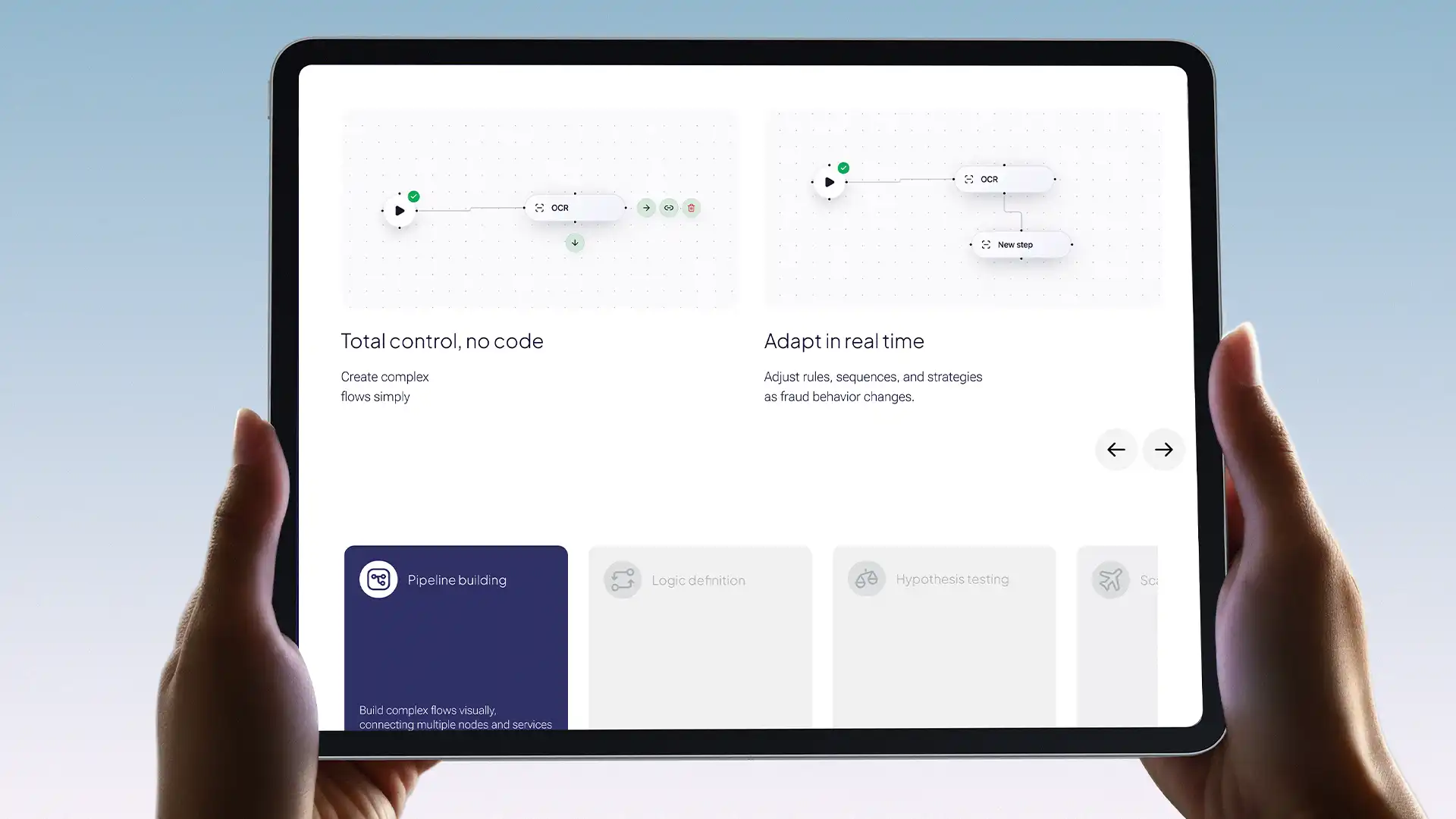
Flow is Certta Pro’s no-code platform for integrating antifraud decisions. It lets risk teams create, manage, and evolve end-to-end decision flows, from the moment a user starts a journey to the final outcome, without depending on the engineering team. What used to take months of roadmap prioritization now takes minutes to configure.
Dynamic Journeys Without Depending on Engineering
Flow is built from nodes: steps that risk managers drag, drop, and connect visually. Each node represents a service, a rule, or a piece of decision logic. The result is a complete visual pipeline that the risk team itself builds, adjusts, and evolves without writing a single line of code.
Available nodes include every Certta Pro product (Liveness, FaceID, DocID, ProfileCheck, VerifAI, AuthID), partners curated by Certta with pre-configured integration, any API on the market via an HTTP Request node, conditional nodes for complex decision logic, and AI and machine learning models for predictive analysis.

Practical examples of what can be configured directly in Flow:
- If device risk analysis flags high risk, route to 3D liveness instead of 2D liveness.
- If a user’s CPF status with Brazil’s Federal Revenue Service shows deceased, end the flow at that point without proceeding.
- If the user is already in the government biometric database, skip document capture.
A/B Testing and Automatic Fallback Between Vendors
Two Flow features deserve specific attention because they solve problems antifraud teams face routinely.
A/B testing lets the system, at a given point in the flow, route users to different services and compile conversion results by variant in real time. Testing one vendor’s liveness against another’s within the same flow, with consolidated results, stops being a months-long project and becomes a configuration that takes minutes.
Automatic fallback solves a critical operational problem: when a vendor goes down or returns an API error, the flow automatically redirects to the next configured vendor, with no manual intervention. The operation keeps running regardless of external outages.
Hubby: The AI Agent That Operates Across the Flow
Hubby is Certta Pro’s artificial intelligence agent. It’s not a chatbot, and that distinction matters: Hubby is an intelligent layer that wraps around the entire Certta ecosystem, understanding every product, every configured flow, and all the intelligence accumulated from past executions. It operates both proactively and reactively, across every product on the platform, for every level of the operation.
The metaphor the product team uses internally captures it well: an antifraud guide in your pocket, always available on the platform, for any level of the operation.
How Hubby Explains Decisions and Detects Patterns
For an operational analyst, Hubby eliminates hours of manual investigation. Instead of navigating multiple compliance dashboards to understand a rejection, the analyst gets the full explanation on a single screen: which services were queried, which rules were applied, what the biometric similarity score was, and why the result came back approved or rejected.
For the antifraud manager, Hubby goes beyond one-off explanations. It continuously analyzes flow performance and proactively flags inefficiencies: a flow that isn’t collecting device data and may be driving up the fraud rate, a risk matrix that’s blocking legitimate users midway through the process, a step that stopped collecting relevant information.
For directors and C-level executives, Hubby generates executive reports, provides a consolidated view of the operation, and supports reporting to regulators such as Brazil’s Central Bank.
AI as Copilot, Not a Substitute for Human Decision-Making
Hubby makes recommendations. It doesn’t change configurations without authorization. Governance stays with the risk team; Hubby extends the analytical capacity of whoever makes the decision.
For complex antifraud flows, Hubby builds the basic structure, the backbone. The branches and customizations are built by the client’s own team, because each business’s specific context determines effectiveness. Hubby’s intelligence grows as more executions pass through the platform: every interaction expands the knowledge available for the next decision.
Flow and Hubby: Distinct Products, Integrated Operation
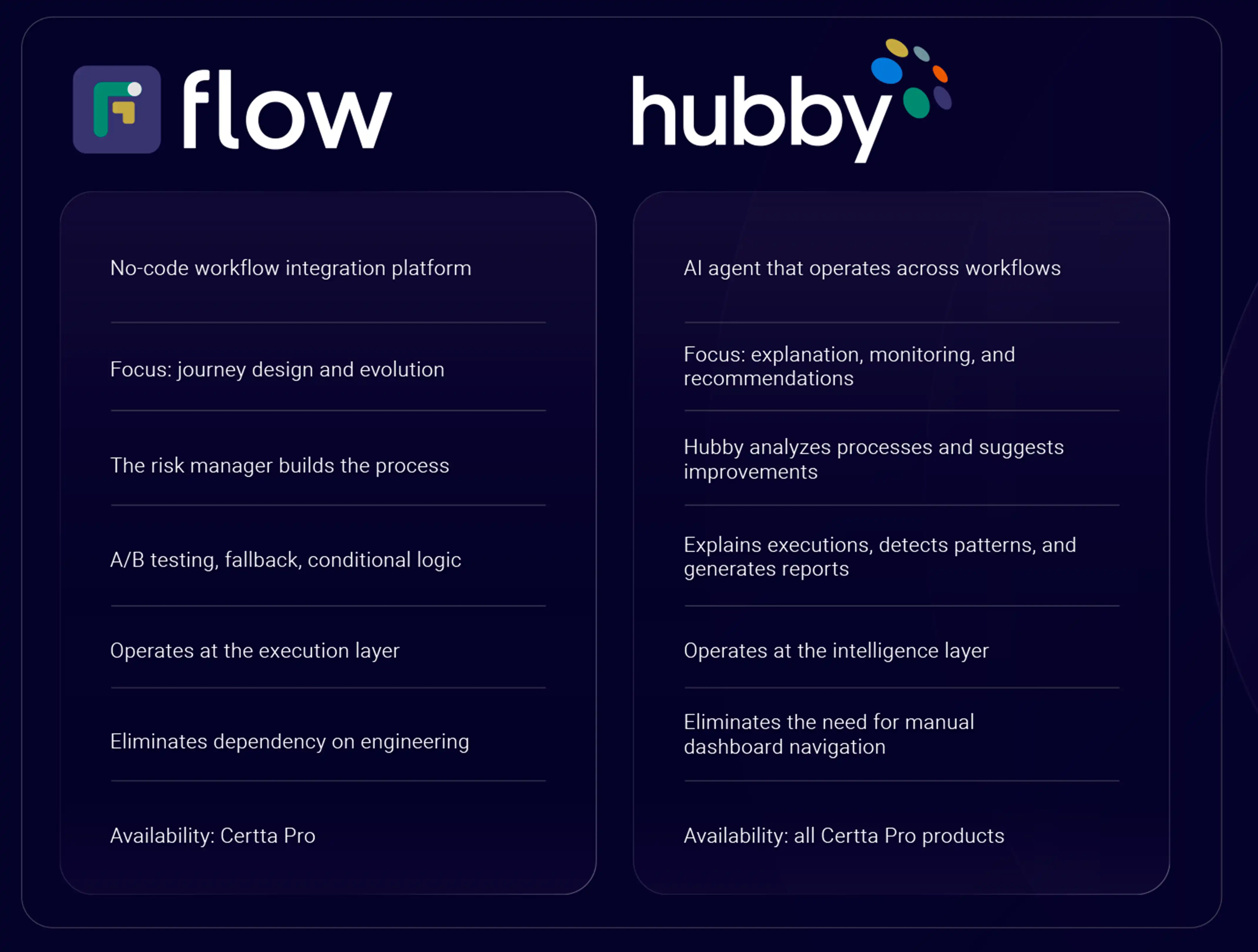
A common question about the two products is where one ends and the other begins. The table below lays out the differences and how they complement each other:
What Changes for Antifraud Teams
The combination of Flow and Hubby changes how risk teams work across three concrete dimensions.
Response speed. The time between identifying a problem, understanding its cause, and implementing a fix drops from weeks to minutes. The risk team no longer depends on development cycles to act.
Decision precision. The operation stops applying the same process to every user. A legitimate, low-risk user moves through a simpler journey; higher-risk situations get additional layers of validation. Calibration is continuous, based on real conversion and fraud data.
Visibility into what’s happening. Every decision comes with an accessible explanation. The analyst doesn’t need to manually reconstruct an execution’s path to understand why a user was rejected. The manager doesn’t need to wait for a weekly report to spot that a rule is generating excessive friction.
Trust Infrastructure Isn’t About Blocking More
The digital trust infrastructure view redefines the goal of antifraud operations. It isn’t only about stopping fraud. It’s about making better decisions at scale: approving more legitimate users, adjusting friction to the real risk of each transaction, and responding to new patterns at the same speed they emerge.
Flow and Hubby are the operational and intelligence layer that makes this possible inside Certta Pro. Not as standalone tools, but as part of a platform that already integrates facial biometrics, document verification, authentication, identity data, and proprietary risk engines.
Want to see Flow in action in your operation?
Talk to a Certta specialist and find out how Flow and Hubby fit into your current antifraud process.