


Updating a machine learning model sounds like routine engineering. In face recognition at scale, it can mean days of uninterrupted processing, weeks of GPU time, and costs running into tens of thousands of dollars per update cycle.
That is the problem Certta's AI team set out to solve. The result is FC-Aligner, a lightweight model that converts face recognition embeddings between model versions, eliminating the need to reprocess an entire database every time the underlying model is updated. The work was presented at NeurIPS 2024, one of the three most important AI conferences in the world.
What is backfilling in face recognition, and why does it cost so much?
Face recognition systems work by comparing mathematical representations of faces called embeddings. Each model version generates its own embeddings, which are incompatible with those produced by earlier or later versions of the same system. When a model is updated, every stored embedding must be regenerated from scratch. The industry calls this process backfilling.
The numbers from Certta's own experience show the scope. A backfilling run over a database of millions of faces increased cloud storage costs by 287.5%, drove up compute expenses by 67.32%, and took five straight days to complete.
René Ferrari, one of the paper's authors, explains what made the problem persistent:
"Every time we updated FaceMatch, all previously generated embeddings became incompatible with the new ones. That forced the team to reprocess millions of faces just to be able to compare existing records against new incoming data." (René Ferrari, AI engineer at Certta)

The problem is not unique to Certta. Backfilling is a well-known bottleneck across the AI industry wherever systems depend on large-scale embeddings, from face recognition to large language models. Practical, lightweight solutions deployable in production environments were still largely missing when the paper was submitted.
How FC-Aligner works
The core idea: forward compatibility alignment
FC-Aligner is built on a specific observation about how FaceMatch models evolve: when two versions share the same neural network architecture and differ only in training data and hyperparameters, it is possible to train a separate lightweight model to translate embeddings from the older space into the newer one.

That translation requires no access to original images, runs on standard CPU hardware, and can be trained in hours rather than days. The trained FC-Aligner sits in production alongside the main face recognition model and handles conversion in real time as new embeddings come in.
FC-Alignerdense
The first architecture, FC-Alignerdense, works like a direct translator: it takes an old embedding and maps it to the new space through a single processing path, quickly and efficiently. In testing, it delivered the best overall balance between false rejection rate and false acceptance rate.
FC-Alignermb
The second architecture, FC-Alignermb, processes the same embedding through three parallel branches before combining the results into a final output. Think of it as a translator that reads the same sentence through three different lenses simultaneously, reading grammar, semantics and context in parallel, before committing to a version. The output is more precise in ambiguous cases, at a slightly higher computational cost. FC-Alignermb outperformed the dense version when the priority was minimizing false acceptance rate, the metric most sensitive to identity fraud risk.
ONNX optimization: making FC-Aligner viable in production
A critical step toward production viability came from converting both architectures to ONNX format. ONNX, short for Open Neural Network Exchange, works like a universal file format for AI models: just as a PDF opens in any reader regardless of what software created it, an ONNX model runs across different environments more efficiently, without requiring the same infrastructure used during training. For FC-Aligner, the ONNX conversion reduced computational cost without any meaningful loss of precision.
"The first attempt did not work because the conversion still had a high processing cost. Then came the idea of converting the models to ONNX, a format that makes the model lighter without sacrificing precision. That's what made the approach viable." (René Ferrari)
With ONNX optimization applied, FC-Aligner converted 20 million embeddings in 55 minutes. The equivalent backfilling process would have taken 5 days.
Results: 11x faster and 2.5x cheaper than backfilling
Testing used approximately 3.36 million embedding pairs for training and validation, plus 14,848 pairs for final evaluation, all drawn from a real-world face recognition system in production.
The results show FC-Aligner maintaining a false rejection rate close to 5%, consistent with the original model, while the false acceptance rate rises from 0.0032% to 0.0048%. That increase of 0.0016 percentage points was considered acceptable for the risk profile of the system under test.
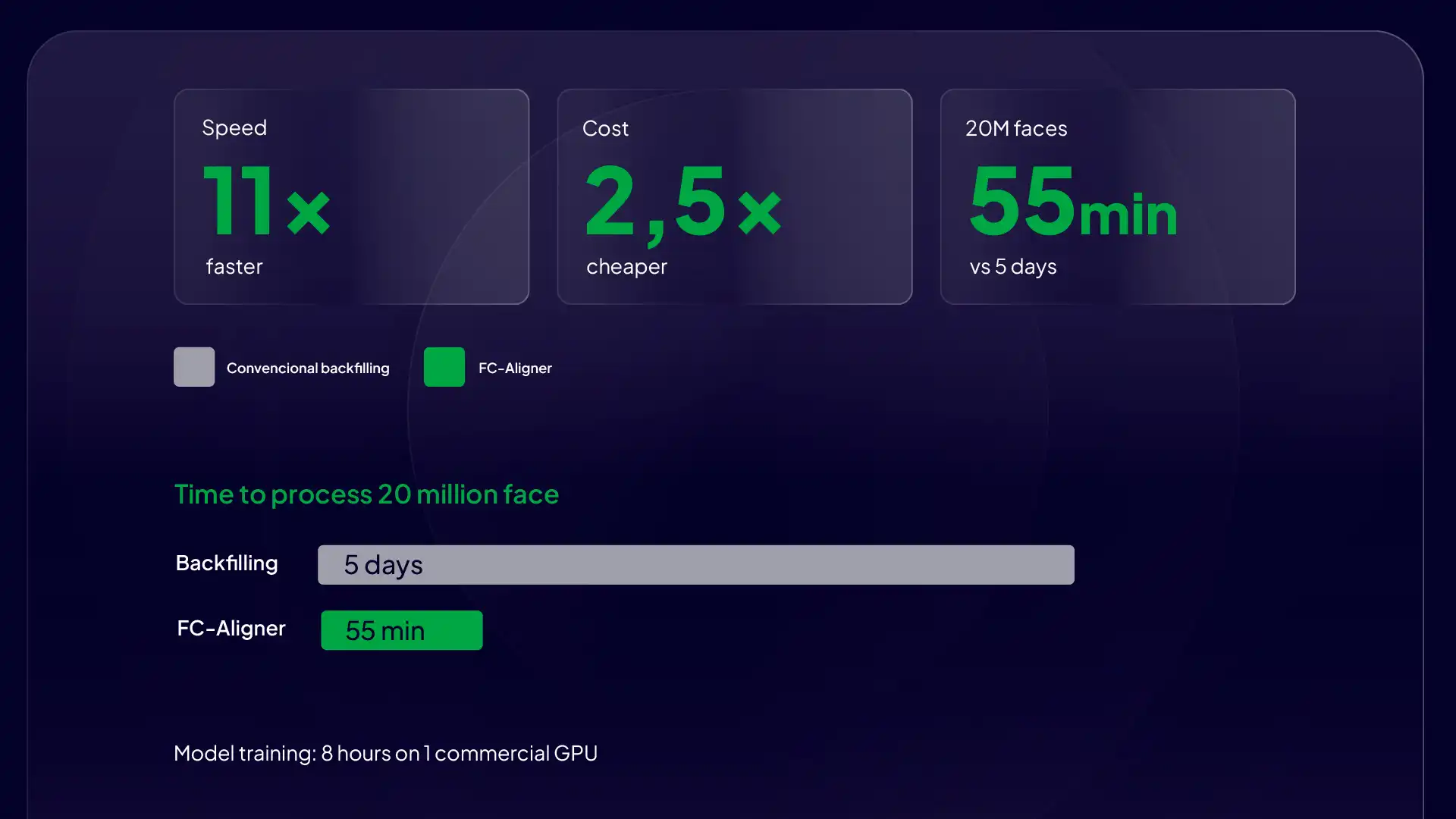
In speed and cost terms, FC-Aligner processes a base of 20 million faces 11 times faster than conventional backfilling and at least 2.5 times cheaper. Model training required 8 hours on a commercial GPU, compared to 5 days of continuous processing for a full backfilling run.
To make this concrete: picture a fintech company with millions of enrolled customers that needs to update its face recognition model for account opening. With conventional backfilling, the engineering team would have to rerun the entire database, which at that scale could mean two or three days of dedicated servers running at full capacity. During that window, any comparison between an existing enrollment and a new identity check would be unreliable. With FC-Aligner, the same team converts all embeddings in a few hours on standard machines without interrupting operations.
Álvaro Spies Nolibos, also a paper author, puts the cost in perspective for enterprise-scale biometric operations:
"When you're dealing with large companies that run biometrics, you're talking about millions of faces. Running a heavy AI model that requires GPU across that many inferences can mean days or weeks of processing and costs reaching tens of thousands of dollars per update cycle. FC-Aligner simply translates the embeddings from one model to the other without needing GPU in production. The whole process becomes significantly faster and significantly cheaper." (Álvaro Spies Nolibos, AI engineer at Certta)

NeurIPS 2024: academic recognition for an industry problem
NeurIPS, short for Conference on Neural Information Processing Systems, is one of the three most important AI conferences in the world, held annually since 1987. FC-Aligner was presented in December 2024 in Vancouver, Canada, via LatinX in AI, a NeurIPS workshop focused on Latin American researchers in the field.
René Ferrari describes how the work landed at the conference:
"It was a meaningful publication because backfilling is a widespread problem in AI and no practical solution had been published yet. Getting accepted at NeurIPS signaled that the problem we were tackling had been recognized as a legitimate research problem." (René Ferrari)
The paper has been publicly available since its presentation. It can be accessed through the NeurIPS virtual archive and OpenReview.
Beyond face recognition: next applications in LLMs and text embeddings
The paper acknowledges a structural limitation: maintaining and training new FC-Aligners for every model version pair becomes operationally expensive as updates accumulate. A universal aligner remains an open challenge.
The roadmap outlined in the paper includes testing FC-Aligner on domains beyond face recognition, including text embeddings in language models and semantic similarity tasks. The proposed architecture is generic enough to apply to any system that depends on large-scale embeddings.
FC-Aligner is already deployed at Certta: FaceMatch, the company's face comparison system, now handles model updates without interrupting operations or incurring the cost of a full backfilling run. The paper formalizes that solution and gives other teams facing the same problem a tested, production-ready reference implementation.
Frequently asked questions
What is backfilling in AI systems?
Backfilling is the process of reprocessing an entire embedding database when an AI model is updated. Because different model versions generate incompatible representations, all records must be regenerated before comparisons are possible. At scale, this means days of processing and significant infrastructure costs.
What is an embedding in face recognition?
An embedding is a mathematical representation of a face, generated by an AI model from an image. It functions like a digital fingerprint: each face produces a unique array of numerical values that can be compared against other embeddings to determine whether they belong to the same person.
How does FC-Aligner solve the backfilling problem?
FC-Aligner learns to convert embeddings generated by an older model version into the representation space of a newer one. This makes it possible to compare existing records against newly generated embeddings without reprocessing the original images. The model is lightweight, runs on CPU, and can be trained in hours.
Does FC-Aligner affect face recognition accuracy?
The false rejection rate stays close to 5%, consistent with the original model. The false acceptance rate increases from 0.0032% to 0.0048%, a rise of 0.0016 percentage points considered acceptable for the risk level of the system tested.
Can FC-Aligner be applied to systems other than face recognition?
Yes. The architecture is domain-agnostic and was designed to apply to any system that depends on large-scale embeddings, including language models and semantic search. Planned next steps include testing on text embeddings.
What is NeurIPS and why does a presentation there matter?
NeurIPS is the Conference on Neural Information Processing Systems, one of the three most important AI conferences globally. Through LatinX in AI in 2024, the work received formal peer-reviewed recognition via the LXAI Journal, extending its reach across the research community.
Key concepts in this article
Embedding: a numerical representation of an image or text generated by an AI model. In face recognition, it functions as a digital fingerprint of a face, enabling identity comparisons without storing the original image.
Backfilling: the process of reprocessing an entire embedding database after an AI model update. Required because different model versions produce incompatible representations.
Forward compatibility: a strategy that translates embeddings from older model versions into the representation space of newer ones, without requiring access to original images or data.
ONNX (Open Neural Network Exchange): an open format for AI models that reduces size and computational cost without compromising precision. Enables models trained in different frameworks to run efficiently across environments.
FAR (False Acceptance Rate): in biometric systems, the probability of the system incorrectly accepting two different identities as the same person. The metric most sensitive to identity fraud risk.
FRR (False Rejection Rate): in biometric systems, the probability of the system incorrectly rejecting two images of the same person as different identities.
NeurIPS: Conference on Neural Information Processing Systems. One of the three most important annual AI research conferences globally, bringing together academic and industry researchers.
LatinX in AI (LXAI): organization and NeurIPS workshop focused on Latin American AI researchers. The LXAI Journal publishes workshop papers through formal editorial review.
Sources
Vieira-e-Silva, A. L., Ferrari, R., Nolibos, A., Zanoni Felipe, G. FC-Aligner: A Lightweight Regressor Model for Embedding Space Conversion. Latinx in AI @ NeurIPS-24 (LXAI 2024).
Audio interviews with René Ferrari and Álvaro Nolibos, AI engineers at Certta, conducted for this article.